

The 100-Day Hiring Countdown: What UK Startups Should Do Before Closing a Funding Round
"We'll hire a head of X when we raise." Investors hear that line every week, and it tells them the opposite of what a founder intends. It says the team plan hasn't been thought through yet - it's been deferred. Among the UK Seed and Series A founders we work with, the ones who raise well have usually done the invisible hiring work in the 100 days before they close, not after.
That gap matters more than most founders think. In a survey of 885 institutional venture capitalists across 681 firms, 47% named the team as the single most important factor in an investment decision - more than product, business model or market combined (NBER, "How Do Venture Capitalists Make Decisions?"). Separately, CB Insights' analysis of startup post-mortems found "not having the right team" among the leading causes of failure, cited in roughly a quarter of cases (CB Insights).
Investors aren't just backing what you've built. They're backing whether you can build the next version of the team that gets you there.
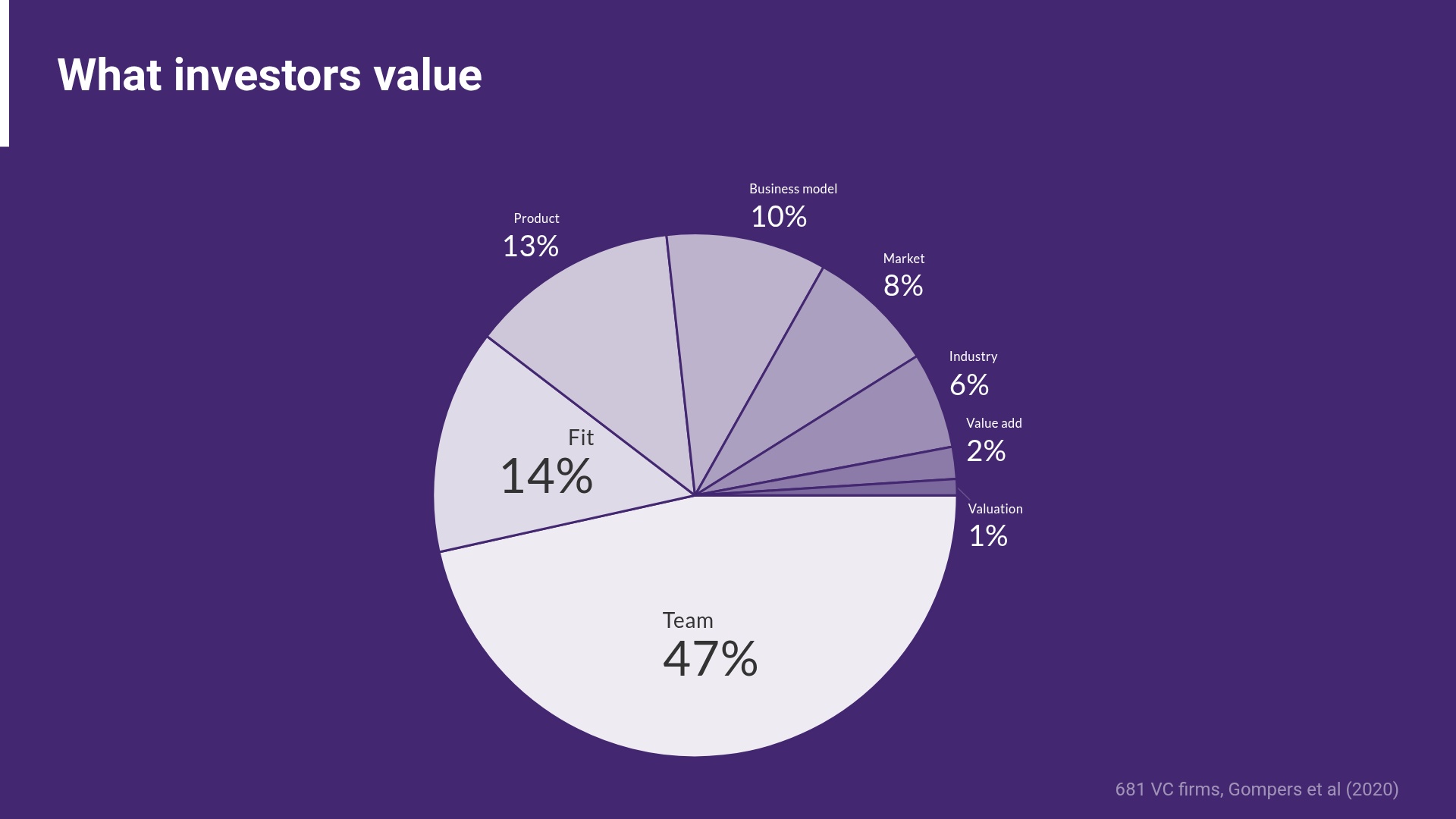
Waiting until the money lands to start on hiring means you're behind before you've begun. Contracts, onboarding, benchmarking and pipeline-building all take weeks you don't get back. The founders who move fastest post-close are the ones who used the fundraise itself to do this work in parallel, not after.
How much you raise changes the shape of the plan
The size of the round shapes not just how many people you can hire, but what kind of hiring makes sense - worth having a rough plan for more than one outcome before you know the final number.
| Raise size (indicative) | What this typically funds | Where founders often go wrong |
|---|---|---|
| Pre-seed / small seed (under £500k) | 1-2 critical hires, often supplemented by contractors, advisors or fractional leadership | Trying to make a permanent, senior hire the round can't really sustain past 12 months |
| Seed (£500k-£2m) | 2-4 permanent hires across a 12-18 month org chart, first real functional leads | Hiring senior titles too early instead of the person who can do the job now |
| Series A (£2m-£10m+) | Building out full functions, first genuine VP/Head-of layer, often the first dedicated People or Ops hire | Treating the hiring plan as fixed rather than milestone-triggered |
Founders who present investors with one fixed plan regardless of the amount raised tend to get more scrutiny, not less - it signals the plan wasn't pressure-tested against a range of outcomes.
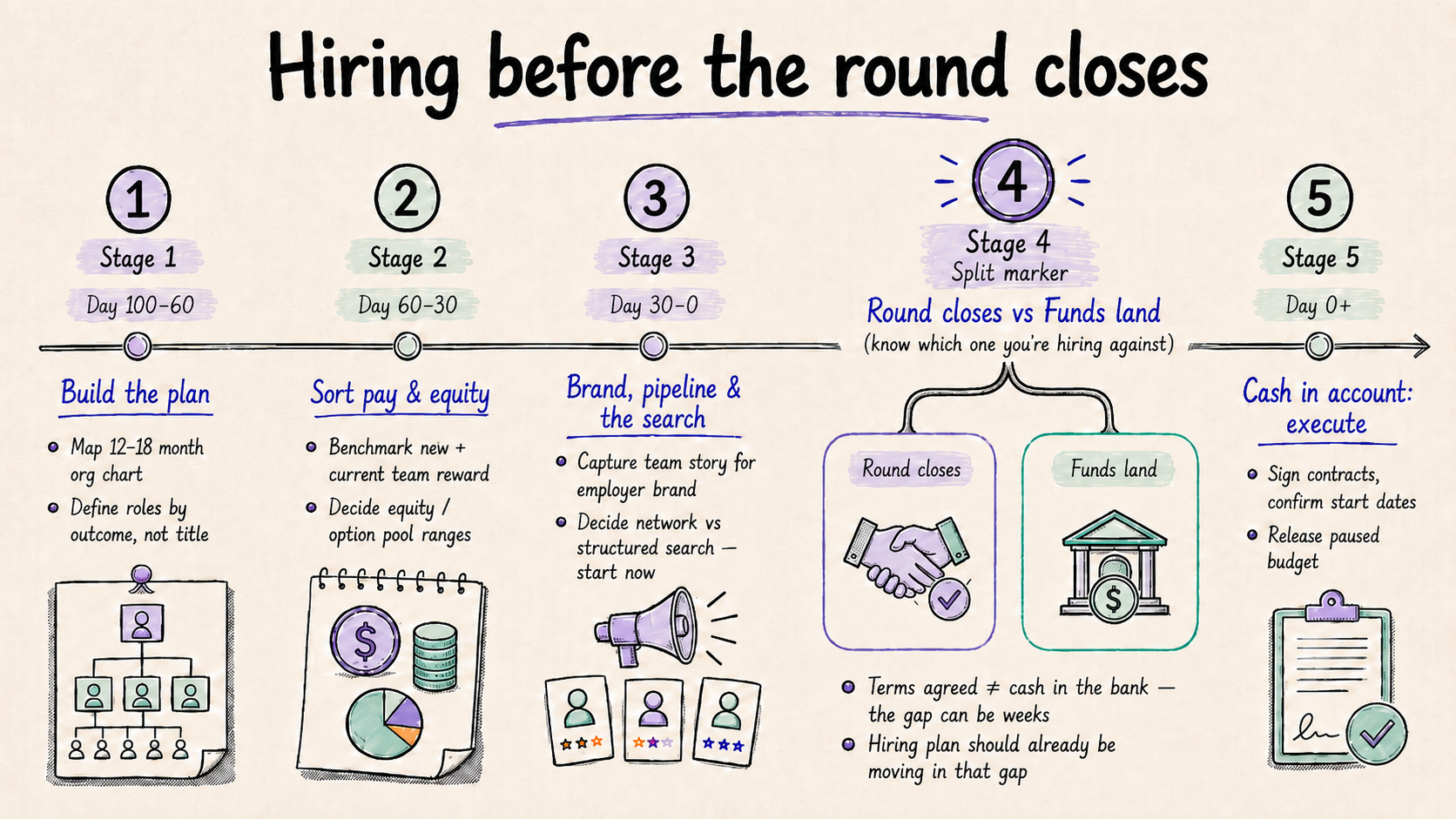
100-60 days out: build the plan investors will actually believe
Start with an org chart mapping people needs over the next 12-18 months, not a wishlist of job titles. This is where most founders go wrong first - they reach for a senior title before they've defined the outcome.
A founder we worked with recently wanted to bring her technology team in-house and started with a plan to hire four permanent people. Some of those roles were going to be genuinely hard, and expensive, to fill. Once we'd worked through the org chart together, she moved to two priority permanent hires supported by a fractional CTO - more confidence in the hires that mattered most, and real savings without losing pace.
The same pattern shows up at the individual-role level. Founders often ask for a CTO when the job is 90% coding. You can call that person a CTO if you want, but if the budget, team and strategy around them doesn't match what a CTO would expect to walk into, you'll either overpay, hire someone who's under-stretched and disengaged, or both. The fix isn't a better job title. It's being specific about the problem this person is solving and the level of leadership actually needed right now - not the leadership team you'll have in 18 months.
| Vague ask | Better question |
|---|---|
| "We need a CTO" | "What technical problem are we solving in the next 6 months, and who can actually solve it?" |
| "We need a VP of Sales" | "Are we trying to land 3 logos to prove the model, or generate £100k to extend runway?" |
| "We need someone senior" | "Are we hiring someone to lead the function eventually, or to do the job now?" |
Some hires are also worth flagging differently depending on urgency. A few should be made as soon as you find the right person, because the opportunity is time-sensitive. Others are milestone-triggered - only made once you hit a specific customer count, revenue figure or delivery threshold. Being explicit about which is which makes the plan far easier to defend at investment committee.
It's also worth building in a discipline several experienced CTOs told us their own investors now expect: a short written case for why a hire is the right call, versus investing in a tool or process instead, before the budget gets committed.
60-30 days out: sort out pay, equity and your existing team
This phase isn't just about benchmarking roles you haven't filled yet. It's about your current team too - and it's easy to skip because there's no external pressure forcing the conversation.
Benchmark reward for the roles you're about to hire, and the people already in the building. Getting this wrong in either direction costs you. Underpay new hires relative to the market and you can't close them. Underpay your existing team relative to what the new hires are getting and you create resentment - or lose people - right when you need continuity most.
One founder we advised had budgeted 15% of salary into pension contributions across the board, simply because that's what he'd had in his own corporate career. Once we talked through what startup talent actually values, he moved that spend into a flexible benefits platform instead - some of the team kept it as pension, others put it toward healthcare or a gym membership. Same cost, but better retention, because it widened who the offer actually appealed to.
Decide what "fair" looks like on equity before you're negotiating it under time pressure. Salary benchmarking is relatively easy to find online. Option pools are not - most founders are guessing. Index Ventures' option pool calculator is a useful starting point if you don't already have investors or slightly-ahead founders to sense-check against: you put in raise size, valuation and hiring level, and it gives you a reasonable range by stage and geography.
This is also the moment to think about who on your existing team has earned a promotion or a pay increase off the back of what the raise will let you build - not just who you're about to hire externally. A credible team plan to investors includes both.
StudentCrowd, the SaaS student review platform, is a good illustration of doing this pre-work properly. They engaged us having just secured £2.55 million of investment, and the work started with salary benchmarking, org chart planning and interview process design - all before a single CV was sent. That groundwork is what let them move fast once the campaign launched: six hires across sales, marketing and partnerships in three months.
30-0 days out: your employer brand
Time spent on employer brand before you close is what lets you move fast the moment you can hire. This isn't a rebrand exercise - it's capturing what your current team already knows about why the business is worth joining, and using it to tell a clearer story to the people you haven't met yet.
One of the scaleups we supported, Clue, works in preventing human trafficking, environmental crime and cyber crime. They built simple video content - team members talking about what they'd actually done that day, tied back to the mission - and it consistently outperformed anything built around salary or perks. We worked as their talent partner for over two years, hiring 50+ people across tech, product and commercial.
That story mattered beyond candidate quality too. Clue's £5 million Series A raise came together while we were their talent partner, and being able to point investors to a trusted recruitment partner removed one more question from the room. Here's how their CEO put it, direct from their case study on our site:
"To our investors, we say we've got a Bristol-based recruitment partner. Their reaction is 'that's brilliant!', because that's the main thing they want to know. Can you scale and find good people? We tell them we've been working with a recruiter, in tech and elsewhere, and they've been brilliant – tick!"
Clare Elford, CEO, Clue Software
A credible pipeline story removes a risk from the deal, which is exactly what investors are pricing in when 47% of them say team is the deciding factor.
It's tempting to think this gets easier once funding is public. It doesn't. Post an advert once your round is out there and you'll get plenty of interest - but more interest isn't automatically a good thing. On average, only around 20% of the market is actively job-seeking at any time, so a flood of applicants tells you more about visibility than about quality.
It also doesn't solve your actual problem. On our own LinkedIn job postings over the past 12 months, we've averaged close to 300 applications per role, and most of it is noise - AI-generated CVs, spray-and-pray applicants, very little signal about who's actually right.
The real cost lands after you've closed. You'll be busy delivering on everything you told investors you'd deliver on, and you won't have the spare hours to wade through 300 applications looking for the handful of good people buried in there. A hiring strategy built entirely around posting and hoping finds you the people who are visible, not the people who are best - and it costs you time you won't have.
Why the fundraise is the moment to look past your network
This is also when you decide whether a key hire runs through your network or a structured search - and for a lot of founders, the fundraise itself is the moment to make that leap. Your network got you here, but it's also finite, and it's easy to keep defaulting to "does anyone know someone" long after that approach has stopped serving you well.
A raise is often the first time it's genuinely worth looking at the whole of the market rather than your own address book - partly for reach, but also because a network-only search tends to surface people who look and think like you and the people you already know, which isn't the same as finding the best person for the role.
That decision needs to happen now, not once the money's in the account. A proper search has its own timeline: sourcing, interviewing, offer, and then whatever notice period the person you actually want is serving. Wait until funds land to start that clock and you can easily be six months past close before someone's actually in the seat.
We recently worked with a company closing a Series A extension who started their hiring plan with us well before the round had landed. They knew that waiting for cash in the bank to kick off a search would stack a full recruitment timeline and a notice period on top of a close that was already taking longer than planned. Engaging early meant the search ran in parallel with the final stretch of the round, and the offer was timed to land close to when the funding actually did.
Being upfront with candidates about where you actually are in the raise helps here, not hurts. Most candidates you'll talk to before a round has closed will ask directly where things stand, and the honest answer is often "not fully committed yet." Say so. Founders sometimes hold off engaging candidates at all until they can offer complete certainty, but startup candidates generally understand that funding is a moving target, not a fixed date on a calendar - and they'll trust you more for being straight about it than for going quiet until everything's signed.
What waiting actually costs, on a real timeline
The cost of waiting compounds fastest on senior, longer-cycle hires. Take a senior sales leader - a hire many businesses make around late seed or Series A. If they're selling into an enterprise cycle that runs 6-12 months, and you don't start the search until after you've closed, you're looking at roughly a 3-month hiring campaign, then a 3-month notice period, then the sales cycle itself - 12-18 months, in a worst case, before that hire puts a pound into your revenue figures. You can compress plenty of that. What you can't do is get back the months lost by waiting for day zero to start the clock.
"Closing" and the money landing aren't always the same day
Worth being precise about this, because it changes how you should plan. Terms can be agreed and the round can be publicly "closed" weeks before funds are actually wired into your account - the legal process, conditions, and mechanics of the specific deal all add time on top of the headline close date. If your hiring plan only switches on once cash is physically in the bank, you've likely already lost weeks you didn't need to lose. Know which milestone you're actually planning against, and don't assume "closed" means "spendable" on the same day.
Once the cash is actually in the account
If you've done the work above, this stage is mostly paperwork and start dates - the hiring itself has already started. What changes here is that you can finally commit: sign contracts, confirm start dates, and release budget for anything that was paused waiting on funds rather than waiting on decisions.
Your first senior hire still needs more upfront clarity than any other, because you're least equipped to evaluate it well. If you've never hired a VP of Sales or a Head of Engineering before, you're assessing someone whose job you may not fully understand yourself. Get specific, ideally before you've even started the search: what does success look like in 18 months, what's the market rate and market pool for this role specifically (not the generic title), and what's realistic for your stage versus what a board member or advisor assumes you need. Founders who skip this step tend to hire for the title on the LinkedIn profile rather than the problem that actually needs solving.
How ISL Talent can help while you're fundraising
We work with UK venture-backed founders across this exact window - most often in the weeks before a round closes, not after. Most of our clients are Seed to Series B businesses moving from 5 to 50 employees, hiring across technology, commercial and leadership roles, with a lot of our work concentrated in deep tech, SaaS and AI-led businesses specifically.
The pattern that shows up again and again is the one above: founders who engage a recruiter while the round is still in progress are ready to make an offer the week funds land, not six months later once a search has run its full course on top of a notice period.
A number of our founder introductions have actually come the other way round too - existing or new investors introducing us to a portfolio founder specifically to get their hiring plan in shape before a round has closed.
We're not pitching this as something you can only do with a recruiter - plenty of the planning and benchmarking is workable in-house with the right structure. But the search itself has a timeline that doesn't compress just because you're eager to move, which is exactly why it's worth starting before you close, not after.
We've also made investor introductions for founders through our own network of angels and VCs when the conversation naturally goes that way, so if fundraising itself is part of what's on your mind, that's worth raising too.
What this means for you
The 100 days before you close is the one period where you can do this hiring work without the pressure of an open role and a ticking clock - and investors are already assessing whether your team plan is credible while you're in it. The work pays twice: it gets you ready to hire the moment the money lands, and it makes the round easier to close in the first place. If a key hire is part of that plan, decide how you'll find them now too - the search has its own timeline, and day zero doesn't buy back the weeks you'd lose waiting for it.
If you're heading into a raise in the next few months and want to pressure-test your hiring plan, or start a key search before you close rather than after, get in touch - we're happy to talk it through.


What are you doing to combat proximity bias in your startup?


How to let your personality shine through in your CV

Corporate social responsibility for tech SME's